Alternatives to Boarding Up Windows
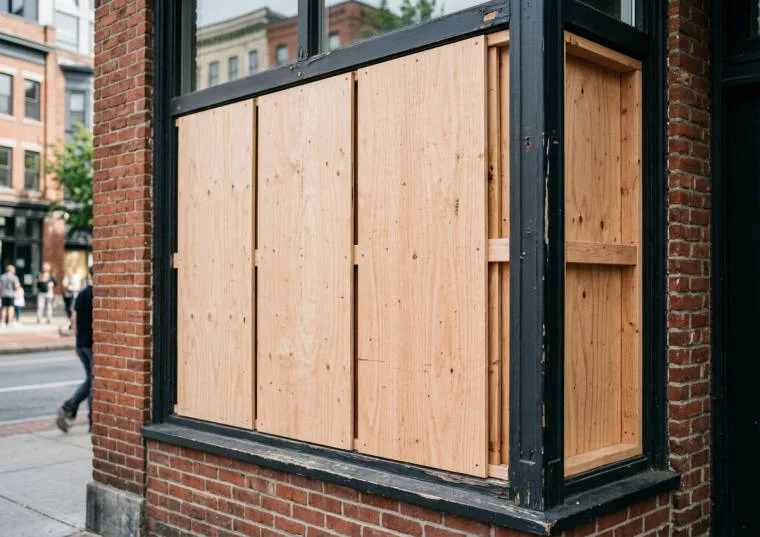
When a window breaks, plywood is the first thing most people think of — and it is usually the right answer. But it is not the only one. Clear polycarbonate boarding, security film, and shutters each have a place, and choosing the wrong one is how a property ends up boarded for a month when it could have been secured and presentable in a night.
This guide compares the four options — plywood board up, clearboarding, security film, and shutters — and explains when each one fits. The short version: board up wins on speed and on a broken window. The others win when the window is not broken yet, or when the property has to keep looking open while it is secured.
Plywood Board Up: Fast and Strong
Plywood is the standard for a reason. A 5/8-inch CDX plywood panel, cut to the opening, backed with 2x4 bracing, and fastened with anti-pry screws, is strong, fast to install, and it holds against weather and against anyone trying to get in. It is the right choice for a broken window, a break-in, a fire, and a vacant property — any opening that has to be closed tonight.
The drawback is the obvious one: plywood is opaque. A boarded window leaves the room dark, and a boarded storefront looks closed — which matters for a business that has to keep trading and for a home in a neighborhood where a boarded window attracts attention. Plywood is also temporary: it is a securing, not a repair, and the glass still has to be replaced.
Clearboarding: Light Through, Security Intact
Clearboarding is a clear polycarbonate panel cut to the opening and fastened the same way as plywood. It is nearly as strong as plywood, it lets daylight through, and from the street it looks far better than a plywood panel — a storefront with clearboarding still looks open, and a home with clearboarding still has light in the room.
Clearboarding costs more than plywood, and it is the right choice when the property has to stay presentable while it is secured: a shop that has to keep trading, a home where a boarded window would leave a room dark for weeks, a property in a neighborhood where a plywood panel draws attention. It is installed the same night as a plywood board up, by the same crew, with the same fasteners.
Security Film: Prevention, Not Repair
Security film is a clear film applied to the inside of a window. It holds the glass together when it breaks — the pane cracks, but the film keeps the fragments in the frame, and the window stays closed. It is a good option for a window that has not broken yet: a shop that wants to slow down a smash-and-grab, a home that wants the glass to hold in a storm.
But security film is prevention, not repair. It does not fix a window that is already broken, and it does not close an opening that is already open. A window with security film that has been smashed still needs to be boarded up — the film holds the glass, but the glass is broken, and the window is not secure. Film is what you install before the break. Board up is what you do after it.
Shutters: For Storms, Not Break-Ins
Shutters — storm shutters, rolling shutters, and hurricane shutters — are built for weather. They close over a window before a storm, they hold against wind and flying debris, and they can be opened again when the storm passes. In a hurricane zone, they are the standard. In Orange County, where the risk is a break-in or a fire rather than a hurricane, they are less common — but they are still an option for a property that faces repeated storm damage.
Shutters are not a repair for a broken window. They are installed before the damage, they are expensive, and they need a professional installation. A broken window with a shutter over it is still a broken window — the shutter covers it, but the glass is broken, and the window is not secure until it is boarded and the glass is replaced.
Board Up + Fencing for Vacant Properties
For a vacant property, the strongest answer is not one option but two: board up on the openings and fencing around the perimeter. The fence keeps people away from the building, and the board up keeps them out of it. A vacant property with a fence and no board up is a property with an open door behind the fence. A vacant property with a board up and no fence is a property anyone can walk up to and test.
We install both in one visit. The crew boards the openings, then runs temporary chain-link fencing around the perimeter, sets the gate, and locks it. The record covers both — what was boarded, what was fenced, and where the gate and the lock are. If the property needs the fence for months and the board up for weeks, the board up comes down when the glass goes in and the fence stays until the work is done. One call, one crew, one record.
Which One Fits Your Situation?
If the window is already broken, board it up — plywood for most jobs, clearboarding when the property has to stay presentable. That is the answer for a break-in, a fire, a storm, and a vacant property. The board up is the same night, the glass is measured on the spot, and the property is secure until the replacement is installed.
If the window is not broken yet, think about prevention: security film for a shop that wants to slow down a smash-and-grab, shutters for a property that faces repeated storm damage. And if the property is vacant, the answer is board up plus fencing — the fence keeps people away from the building, and the board up keeps them out of it. Whatever the situation, call Board Up USA at (714) 942-5099 and we will tell you plainly which option fits — and which one does not.
Your Property Secured Tonight
If your window is broken right now, do not wait for the repair — secure the property first. Board Up USA dispatches 24/7 across Orange County, typically within 30 to 60 minutes, with a free quote before work starts, glass debris cleanup included, and photo documentation for your insurance claim.
Request a Free Quote
Get a fast response for your Board Up Service